 Proudly Albertan

Buying a newly renovated house is an amazing chance. Upgrading the kitchen, installing new bathrooms, building a deck, or expanding the garage will enhance your property’s value and will also help you from having to do renovations on your own. Before making the deal, however, there is one important paper you should not forget about – the Real Property Report (RPR).
In Alberta, a Real Property Report provides valuable information about property boundaries, buildings, structures, and improvements. It helps buyers understand whether the visible features of a property are correctly positioned within the boundaries and whether certain improvements may raise municipal compliance concerns.
It is even more crucial when buying a newly renovated home since the current RPR will not take into account the recent renovations made. In case of additions such as a deck, an extension of the garage, a fence or some other addition, the report might have to be revised. Learning about the RPR before buying your house is important for a number of reasons.
What Is a Real Property Report in Alberta?
A Real Property Report is a legal document prepared by an Alberta Land Surveyor. It illustrates the boundaries of a property and identifies the location of visible improvements in relation to those boundaries.
Unlike a regular property listing or floor plan, an RPR provides a survey-based representation of the land and its improvements.
A typical RPR includes:
- Legal description and municipal address of the property.
- Property boundaries and dimensions.
- Location of the house, garage, and other structures.
- Fences, decks, sheds, and retaining walls, where applicable.
- Easements and rights of way.
- Visible encroachments affecting the property.
- Relevant municipal compliance information, where endorsed.
The document helps buyers, sellers, lenders, and municipalities understand how the property and its improvements relate to the registered land boundaries. It can also reveal whether a structure extends beyond the property line or is positioned too close to a boundary.
According to the Alberta Land Surveyors’ Association, an RPR provides a snapshot of the property’s improvements and their positions when the survey is completed.
Why Does an RPR Matter When Buying a Recently Renovated Home?
A recently renovated property may look completely different from the one originally shown in its previous survey. However, an older RPR does not automatically reflect those changes.
For example, the previous owner may have:
- Constructed a new wooden deck.
- Extended the existing garage.
- Installed a permanent backyard fence.
- Added a storage shed.
- Built a retaining wall.
- Expanded an existing outdoor structure.
In case such improvements are not available in the current RPR, then the RPR would not be able to provide an accurate picture of the current state of the property.
It is one of the significant problems for buyers because you can purchase the property assuming everything to be in order only to find out later that some improvements need to be approved or fixed.
Updating the RPR can allow determining if the improvements on the property are properly reflected.
5 Important RPR Checks Before Buying a Renovated Property
1. Check Whether the RPR Includes All Recent Renovations
The first step is to establish whether the present RPR is reflecting the layout and improvements of the property.
Compare the information provided by the report with what you actually observe during your property inspection. Should there be any additional structures such as deck, garage extension, shed or fence, you need to make sure they are reflected in the report.
To make things clearer, let us assume that you have bought a renovated home in Edmonton that boasts a wonderful backyard deck. The report, which was issued several years ago by the seller, does not contain this improvement as it has been done after the preparation of the report. Thus, the report may not accurately represent your property anymore.
Consult with the seller whether there is any updated report available. Otherwise, discuss with your real estate lawyer whether you should obtain a new survey.
2. Look for Encroachments and Boundary Issues
Sometimes renovations can pose some surprises for boundary-related issues, especially in cases where buildings are extended or erected near neighboring land.
An encroachment is a situation whereby the structure, improvement, or building encroaches beyond the boundary of the land.
For example, an extended garage could encroach beyond the boundary line, or a fence erected in a landscaping project could fail to conform to the boundary line.
An RPR will assist you to recognize encroachments and the relation of the structures to the boundaries.
Take special note of garages, fences, decks, sheds, and other improvements. In case the report raises the issue of an encroachment, please consult your lawyer on how to proceed.
3. Verify Municipal Compliance and Development Permits
The presence of an updated RPR does not guarantee that all the renovations in question are appropriately approved by the municipality.
In Edmonton, the issuance of a municipal Compliance Certificate ensures that the buildings or structures located on the RPR are in compliance with the zoning regulations and have appropriate development permits.
That’s one thing to note. The structure can be found correctly situated within the property, but at the same time, it has some municipal compliance problems.
It can happen, for instance, that the newly constructed garage is not compliant with the setbacks, or that the deck was constructed without obtaining the proper development permit.
When you decide to buy, see if your RPR has any municipal compliance documentation. If any problems exist, see if they are resolved.
Keep in mind that a municipal Compliance Certificate is not a replacement of a building inspection.
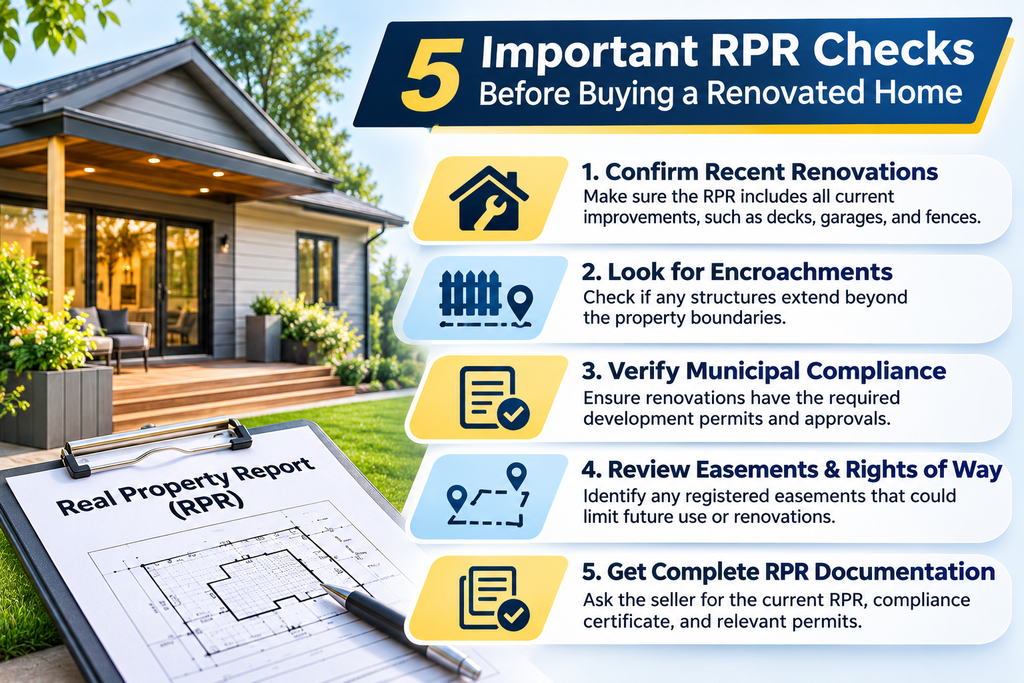
4. Examine Easements and Rights of Way
The renovated premises may contain easements or rights-of-way, which limit how certain sections of land can be used.
An easement provides another individual or group of individuals the right to use a particular portion of the property, for a predetermined or legally accepted reason. They are most often linked to the utility facilities, drainage, access, or adjacent lands.
Let’s say you buy a home, with the intention of adding an extension or building something else on the backyard patio. However, there happens to be a utility easement covering the planned area, and it could limit your ability to renovate.
This is one of the issues that will be shown on an RPR, allowing a potential buyer to determine their presence in the property.
It’s especially crucial to consider these points when planning future renovations on the premises.
5. Confirm That the Seller Can Provide the Required RPR Documentation
In accordance with the standard residential Alberta real estate contract for sale, the seller is usually obligated to supply the RPR along with proof of municipal compliance, provided there are no conditions in the contract.
It would be incorrect, however, to conclude that all reports are equal or that every renovation is documented identically.
What matters is whether the report truly represents the property.
Ask the seller for:
- A copy of the existing RPR.
- Evidence of municipal compliance, where required.
- Relevant development permits for recent improvements.
- Information about any changes made after the original survey.
- Details of any outstanding municipal or boundary concerns.
If the documentation is incomplete, discuss the issue with your real estate lawyer before proceeding towards closing.
Does an Old RPR Become Invalid After Renovations?
An RPR is not supposed to become invalid just because it was created a few years ago. This would only depend on whether the property has undergone any changes since the report was issued.
In case there have been no changes made to the property, then the old report might still be useful. But in case the property has been renovated or some changes have been done to it, the old RPR might need to be updated.
This is because a previous owner might have decided to add a fence or extend the garage after the old survey. According to the Alberta Land Surveyors’ Association, an RPR is invalid in case of improvements or changes.
What Should You Do If the RPR Reveals a Problem?
Discovering an issue on an RPR does not necessarily mean you should immediately walk away from the purchase. However, you should understand the problem before completing the transaction.
Consider taking these steps:
- Request clarification: Ask the seller to explain any missing structures, encroachments, or compliance concerns.
- Consult a land surveyor: If the existing RPR does not reflect recent improvements, ask an Alberta Land Surveyor whether an updated report is necessary.
- Check municipal records: Confirm whether the relevant development permits and compliance requirements have been satisfied.
- Speak with your real estate lawyer: Get advice about the legal implications, contractual obligations, and possible solutions before closing.
In some circumstances, title insurance may be considered as an alternative or additional form of protection. However, it does not automatically replace an RPR or resolve every compliance issue. Its coverage, exclusions, and suitability should be discussed with your lawyer before making a decision.
Get Professional Real Estate Legal Assistance from Peter B Mason Real Estate Lawyers
Buying a recently renovated house is not only about examining the quality of the renovation work and determining the selling price of the house. Another aspect that should be considered when buying a recently renovated house is understanding the legal documents relating to the house. Peter B Mason Real Estate Lawyers offers legal services relating to residential real estate for buyers and sellers in Alberta. Peter B Mason Real Estate Lawyers offers assistance regarding the purchase and sale of houses as well as mortgage transactions of residential properties. If you are going to buy a recently renovated property, then it will be beneficial for you to get some legal advice.
Visit Peter B Mason Real Estate Lawyers to learn more about the firm’s real estate legal services.
Final Thoughts
Though a newly renovated house might appear to be ready to move in straight away, its paperwork should get the same attention as its physical state. An old RPR, unfinished renovations, boundaries encroachments, or other municipal compliance matters could cause problems once the property has been purchased.
Before buying, carefully review the Real Property Report, verify recent renovations, and confirm that the necessary municipal documentation is available.
Taking these precautions and seeking professional advice can help you understand what you are purchasing and protect your investment in Alberta’s residential property market.
Frequently Asked Questions (FAQs)
1. What is a Real Property Report (RPR) in Alberta?
A Real Property Report (RPR) is a legal document prepared by an Alberta Land Surveyor. It shows property boundaries and the location of visible improvements, such as houses, garages, decks, fences, and sheds. It can also identify easements and visible encroachments.
2. Does a Real Property Report become outdated after renovations?
Yes. An RPR may become outdated when permanent improvements or structures are added or modified after the survey date. For example, building a new deck, extending a garage, or installing a permanent fence may require an updated report.
3. What is the difference between an RPR and a Municipal Compliance Certificate?
An RPR shows the property’s boundaries and the location of visible improvements. A Municipal Compliance Certificate is issued after the municipality reviews the RPR to determine whether the identified buildings and structures meet applicable zoning requirements and have the appropriate development permits.