 Proudly Albertan
Purchasing a home in Edmonton is a huge financial decision you have to make. It is true that selection of the correct neighborhood, analysis of the market prices for homes, and the inspection of the structure are all very crucial aspects, but the one thing that you must not neglect at any cost is the property title of the house.
Understanding these details before completing a purchase can help you avoid unexpected legal complications and future expenses. If you are planning to buy a residential property, consulting a professional experienced in real estate law in Edmonton can help you identify potential concerns before they become bigger problems.
Here are six important things you should check on an Edmonton property’s title before signing off on your purchase.

1. Verify the Registered Ownership of the Property
The first step is to verify whether the registered owner of the property is indeed the owner selling the house. The registered owner(s) and the legal description of the property can be found in the land title. This will assist in determining whether the seller has the capacity to transact.
Be very careful if the house being sold has more than one owner. The type of ownership will determine whether all registered owners will have to be involved in the transaction or not. Some additional documents might be required when the property is being sold via an estate or through power of attorney.
It is equally important to verify that the legal description provided for in the land title matches the property being purchased.
The verification process will save you from any hassle later on.
2. Check for Outstanding Mortgages and Financial Charges
A previous mortgage registration is one of the most common registrations that you might come across on the property’s title. In case the owner bought the property through mortgage financing, then the lending institution might still have an outstanding interest on the property.
Other financial registrations might include judgments, builders’ liens or any other type of charge which might impact on the transaction.
While an existing mortgage registration does not automatically imply that the property cannot be sold, it is necessary to clarify the terms of the registration prior to closing. In normal course of events, the lawyer representing the vendor will take care of clearing the existing mortgage out of the sale proceeds.
It is also necessary to give special attention to builders’ liens and judgments as they might have special obligations.
The purpose of title search is to uncover all these registrations so that the lawyer can advise what interest will need to be cleared during the transaction.
3. Look for Easements and Rights of Way
Easement is where a third party has some legal rights to access a part of the land for a particular purpose. The easement is commonly tied to utility services, neighboring lands, drainage and access arrangements.
For instance, the utility company has a right to access the utilities such as electrical lines and water pipes. The neighboring landowner may have a right of way that allows him/her to cross the specified part of the land.
This does not mean that the existence of an easement restricts you from purchasing the land. However, it restricts your usage of certain parts of the land.
Think about a situation where you are buying a house intending to put up a garage or fence the yard. In the future, you realize that the planned construction land is within a utility easement that is registered.
Before deciding to buy that piece of land, look at the location and purpose of any easement and right of way.
4. Identify Restrictive Covenants and Building Restrictions
Restrictive covenants are legally binding restrictions, which could impose restrictions on the usage, development or alteration of the land. Depending on their contents, restrictive covenants could influence such issues as positioning of buildings, any exterior construction, landscaping, fencing and many other changes.
For instance, it could restrict certain construction activities or create requirements regarding the appearance and positioning of the buildings. Such restrictive covenants could be especially relevant for your plans to renovate the house, build any new constructions and make exterior alterations.
The property could appear excellent at first glance, while restrictive covenants could hinder your renovation plans.
In addition, one should note that not all the restrictions have the same effect.
Ask your real estate lawyer to review any restrictive covenants on the title and explain their potential impact. This will help you understand what you can and cannot do with the property after becoming its owner.
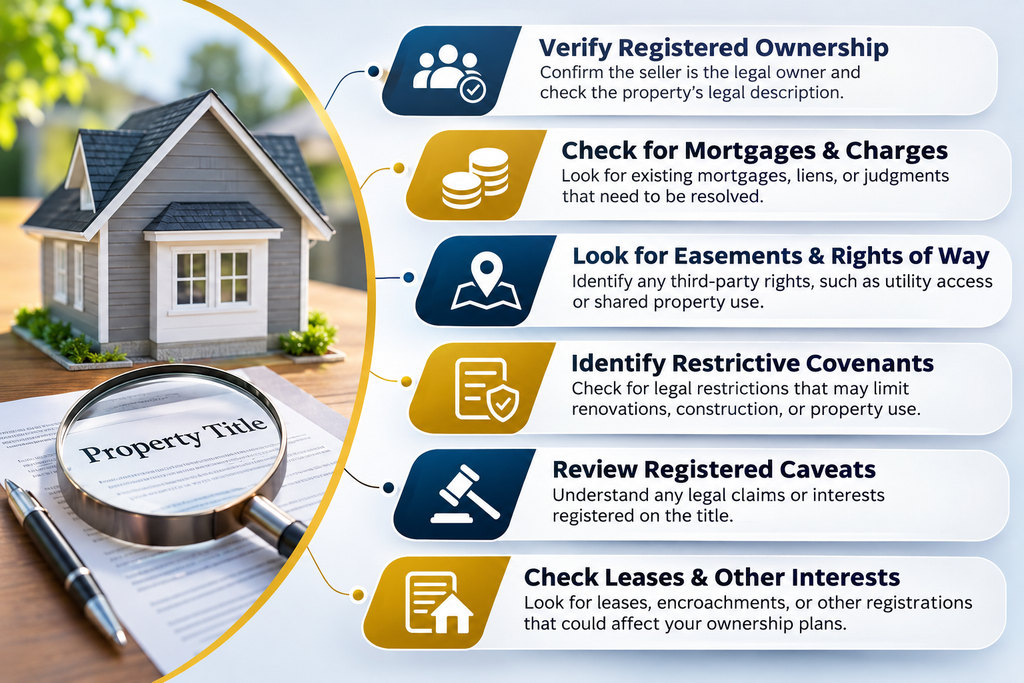
5. Review Registered Caveats and Other Legal Claims
Caveat means an entry on the title of a piece of land informing the public that there is an interest claimed by somebody else over the land.
It could mean that someone has an interest in the land through some form of legal or equitable right of their own.
There are several forms of caveats; these could be caveats for an agreement for sale, contractual interests, etc., involving an interest in ownership of land.
The existence of a caveat on a piece of land does not imply that the land cannot be sold. It is, however, something that you must never take lightly because it might affect your capacity to transfer good title over the land.
The key is knowing why the caveat exists, who placed it and what kind of legal interest it seeks to cover.
Sometimes the caveat needs to be discharged, sometimes withdrawn or sorted out by an appropriate legal arrangement.
Your lawyer will be able to advise you on the best way forward, and you would want to be aware of the consequences of the caveat before buying the property.
6. Examine Leases, Encroachments, and Other Registered Interests
In addition to mortgages, easements, restrictive covenants, and caveats, there may be other registrations that will affect your ownership experience.
A lease or occupancy agreement already in place may impact the time that you can occupy the property. This especially applies if you are buying a property which is currently occupied by tenants.
Another registration to consider is that of an encroachment. Encroachments happen when any structures or improvements overstep the boundaries of the property. An encroachment can be in the form of a fence, garage, driveway, or even other buildings.
Depending on the case, the encroachment may result in boundary issues or may affect any future renovations.
Other registered agreements may have obligations on maintenance, access to the property, or shared property use.
Should you plan to occupy the property immediately, rent it out, or carry out any improvements, your lawyer should review any other registrations on the property and advise you on how it may impact your plans.
Why Is a Property Title Review Important Before Buying a Home?
It might be appealing, have good location, and fall within your budget. Nevertheless, all these considerations will not automatically ensure that the legal title of the property does not have any problems associated with it.
The title search reveals crucial facts, but the legal consequences of the registration need to be addressed by professionals. There are registrations that are standard and there are registrations that need further actions to be taken before you can finalize the deal.
An experienced real estate lawyer can review the title, explain registered interests, identify potential concerns, and coordinate the necessary legal steps before closing.
Seeking advice before completing the purchase also gives you an opportunity to discuss potential issues and understand your options while the transaction is still in progress.
Why Choose Peter B Mason Real Estate Lawyers?
Hiring a lawyer who has adequate skills in this line of work may be a big step for any client in property purchasing. Peter B Mason Real Estate Lawyers is a company that gives legal residential real estate services to purchasers and sellers in Edmonton, Canada. It is a law firm that deals with residential real estate issues, home buying and selling, mortgage issues, and constructions. There are many locations of their offices in Edmonton, and also the company has remote signing, which makes it easier for customers to have the needed legal services at any point during the procedure of buying or selling.
Visit the Residential Real Estate Legal Services page to learn more or contact the firm at 1-866-888-1081.
Final Thoughts
Buying a house goes beyond simply agreeing on the price and executing a purchase agreement. An examination of the title is an important process that may enable you to discover pertinent information such as details regarding the ownership, financial liabilities, easements, covenants, caveats, and any other interest registered against the property.
Here are six aspects that should be considered when purchasing your property in Edmonton. Legal advice will help you realize any possible danger associated with the title.
Title examination today could mean securing the property in future.
Frequently Asked Questions (FAQs)
1. Why is a property title search important when buying a home in Edmonton?
A property title search helps buyers verify registered ownership and identify mortgages, caveats, easements, builders’ liens, and other registered interests. Reviewing these details before closing can help identify potential legal complications and protect your property interests.
Alberta.ca+1
2. What happens if a property has an outstanding mortgage on its title?
An outstanding mortgage does not automatically prevent a property from being sold. However, arrangements must generally be made to pay the outstanding amount and register the mortgage discharge as part of the transaction. A real estate lawyer can help coordinate this process.
Alberta.ca
3. Can easements and restrictive covenants affect my property ownership?
Yes. Easements may give utility providers or neighbouring property owners certain rights to use part of your land. Restrictive covenants may limit construction, renovations, or other property activities. Buyers should understand these restrictions before completing the purchase.